penetration testing
Scoped, time-boxed attempts to break in, with every vulnerability verified and documented with code reproduction steps.
- Web apps, APIs & internal networks
- Free 90-day fix retest included
devwalls security helps organisations find the weak points in their systems, fix them, and prove they stay fixed. Plain language, no jargon, delivered remotely anywhere in the world.
From comprehensive external penetration testing to high-stakes adversary simulations and forensic evidence analysis.
Scoped, time-boxed attempts to break in, with every vulnerability verified and documented with code reproduction steps.
Objective-driven emulation of sophisticated attackers to test whether your SOC and security tools actually detect and stop a breach.
We audit your AWS, Azure, or GCP topology like an attacker: finding privilege escalation paths, open storage, and blast radius chains.
Forensically sound digital evidence, cryptocurrency tracing, BEC triage, and mobile forensics documented for legal scrutiny.
Security is not a binder of checkmarks. It is knowing what breaks, fixing it quickly, and making sure the fix actually holds.
We try to break in, the way a real attacker would, and show you exactly how far we got.
Finding a problem is half the job. We help you fix it, then check that the fix holds.
Clear advice for the people who decide, written in plain language and backed by evidence.
When an email account is breached, cryptocurrency disappears, or internal fraud occurs, we recover digital artifacts, trace the movement of funds, and build an evidentiary record that stands up in a court or insurance dispute.
Tracking diverted funds through blockchain mixers, OTC brokers, and offshore exchange accounts.
Bit-stream physical imaging, deleted message recovery, stalkerware inspection, and device timeline logs.
Open source intelligence mapping undisclosed corporate affiliations, asset structures, and executive backgrounds.
Admissible evidence reports compliant with NDPA 2023, Cybercrimes Act, and ISO/IEC 27037 standards.
Published by Devwalls Research & Engineering. Comprehensive practical blueprints on web exploitation, API security, and cloud attack surface analysis.
Breaking AI: A Practical Guide to Testing LLM Applications and Agents is a comprehensive, hands-on guide to understanding and securing the rapidly evolving world of artificial intelligence.
Written by Divine Chukwu, this book takes security professionals, penetration testers, developers, and AI enthusiasts beyond the chatbot interface to explore how modern AI systems are actually built, where they fail, and how to test them responsibly. You'll learn how to assess prompt injection, system prompt exposure, guardrail weaknesses, RAG and retrieval attacks, vector database security, cross-tenant failures, AI memory risks, tool and function-calling abuse, excessive agency, autonomous agents, multi-agent systems, sandbox escapes, and supply-chain risks. The book also provides a practical methodology for conducting professional AI security assessments—from scoping and threat modelling to testing, evidence collection, and writing security reports. With a dedicated AI Test-Case Library, Engagement Checklist, Sample Reports, and Glossary, Breaking AI gives you a structured foundation for entering the growing field of AI security and AI red teaming. AI security is not just about the model. It's about the prompts, data, tools, agents, integrations, and systems that trust its output. This book teaches you how to test the entire AI stack. By Divine Chukwu | Devwalls Security — Offensive Security for the AI Stack
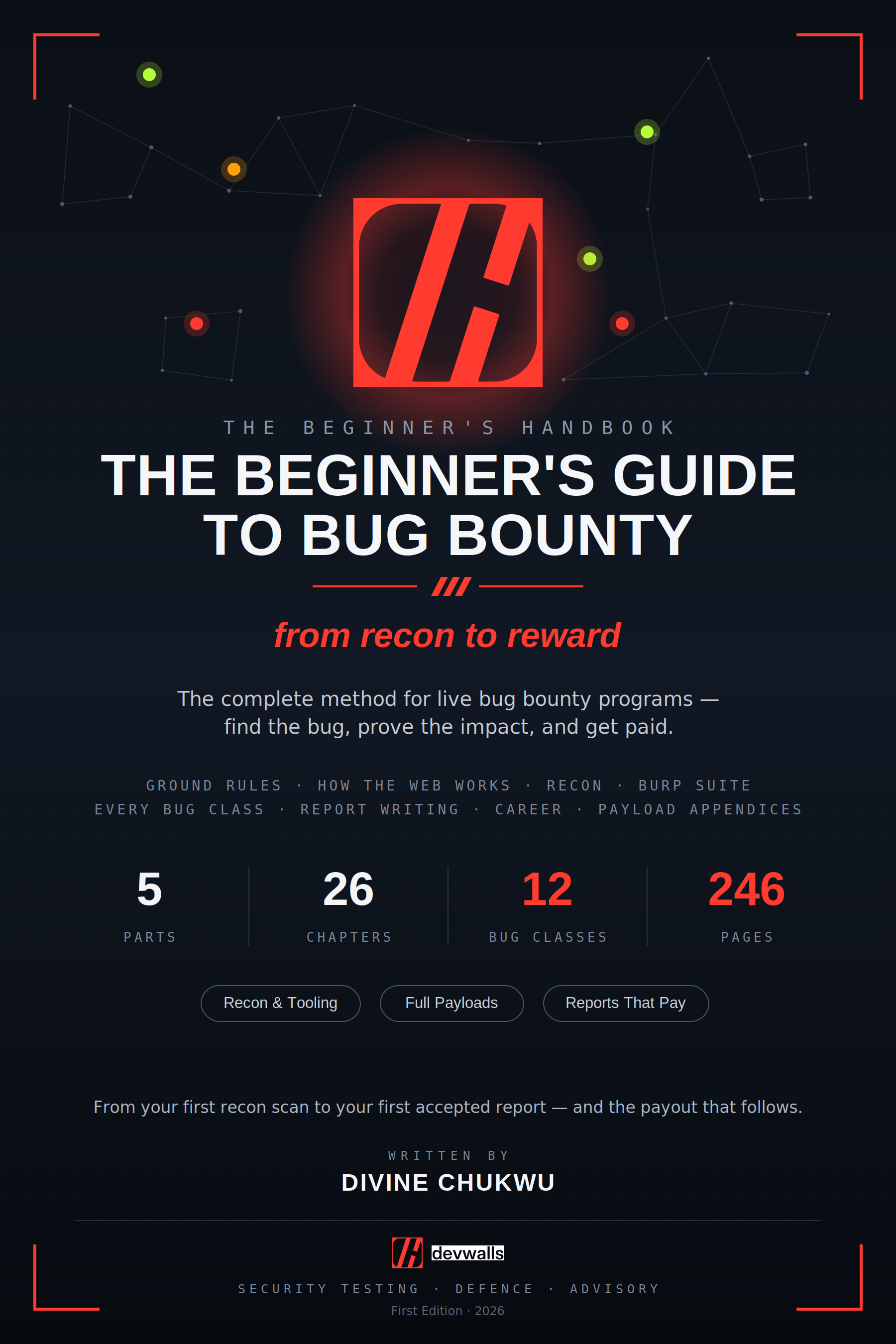
Most people who try bug bounty quit within three months — not because they can't find bugs, but because nobody taught them where to look, how to prove impact without crossing a line, or how to write the report that turns a finding into a payout.
Written by Divine Chukwu and published by Devwalls Security, this 246-page handbook takes you from zero knowledge to your first accepted report. No prior hacking experience required — just the willingness to work through it. Inside, you'll learn: The honest economics of bug bounty — what beginners really earn, and how to pick unglamorous, under-tested programs where you can actually compete The legal ground rules — authorization, scope, and safe harbour across Nigeria, the UK, the US, and the EU, so you never put yourself at risk How the web really works — HTTP, sessions, and the browser security model that every vulnerability exploits A full recon and tooling workflow — Burp Suite from zero, subdomain enumeration, content discovery, and reading JavaScript to map an application Every major vulnerability class, with real payloads and step-by-step exploitation — access control & IDOR, XSS, SQL and other injection, SSRF, CSRF & CORS, authentication and JWT flaws, business logic and file upload, information disclosure, open redirects, path traversal, subdomain takeover, API & GraphQL testing, and race conditions The skill that actually pays — writing reports triagers accept on the first read, handling duplicates and rejections professionally, and climbing toward private, less-crowded programs A sustainable path — building a portfolio, reputation, and a real career in security Plus four practical appendices: a payload & command quick-reference, a printable per-target methodology checklist, a full glossary, and three complete worked sample reports you can model your own on. Every technique is taught the ethical way — prove, don't breach; use your own accounts; keep your proof-of-concepts harmless — because your reputation is the asset that pays you for years. What you get: 246 pages · 5 parts · 26 chapters · 12 vulnerability classes · 4 reference appendices. If you're serious about learning bug bounty properly — and getting paid for it — start here.

Technical teardowns and root cause analyses from real offensive engagements and forensic investigations.
As enterprises connect LLMs to database engines, shell runners, and internal APIs, indirect prompt injection transforms from a chatbot annoyance into a full remote code execution pipeline.
How attackers exploit subtle authorization flaws in REST and GraphQL endpoints to drain customer balances and hijack merchant records, and why Web Application Firewalls (WAFs) fail to detect them.
How misconfigured sts:AssumeRole trust policies and excessive wildcards in secondary AWS accounts allow attackers to escalate from a single container breach to organisation-wide administrative control.
Taught by practising security engineers in live virtual war-rooms. No prior experience required, open to practitioners worldwide.
Ethical hacking with modern AI tools, taught step by step. No experience needed, only the willingness to learn.
A full route from first principles to working in the field, with real assessment experience built in.
We cross-reference every confirmed vulnerability against the governance and regulatory frameworks your auditors demand.
A twenty-minute call is usually enough to tell whether we are the right fit. If we are not, we will say so.